
Story 8
Logistic Support Force Signal
Squadron
Australian Regular Army
Citizen Military Force

Introduction
The 3rd
Lines of Communications Signal Regiment (3 L of C Sig Regt), which
was a Citizen Military Force (CMF) unit was formed in 1959, and was
formerly the 3rd Army Signal Regiment formed in
1954.
In
1960, the Australian Army was reorganised from three Divisions (the
1st, 2nd, and 3rd Divisions) into a
Tropical establishment of two Pentropic divisions (the 1st
and 3rd). The key element of the Pentropic
organisation was the reorganisation of Divisions into five combined
arms Battle Groups (BGs). Each BG consisted of an Infantry
Battalion, Field Artillery Regiment, Engineer Field Squadron,
Signals Troop, and other combat and logistic services, including
Armoured, Aviation and Armoured Personnel Carrier Units, as
required. These battle BGs were commanded by the commanding
officer of their infantry battalion and reported directly to the
headquarters of the Division, as Brigade headquarters were abolished
as part of the reorganisation.

The Infantry
Battalions were expanded into the new large Pentropic Battalions,
the 30 reserve CMF battalions were merged into nine battalions.
There was a similar effect on the other CMF units, with most being
merged into new, larger units.
The Pentropic Division establishment were allocated either a CMF
Signal Squadron attached to an Australian Regular Army (ARA)
Regiment or ARA Signal Squadron attached to a CMF Signal Regiment.
The manning of the ARA staff allotments was allocated from a special
allocation list known as “Shadow Postings”. The members of the
list were still employed in a static unit, and were drafted to the
Field Force unit when required.
Sig's Alfie Donnison, Chris Wolfenden, Kevin Schmidt, Ernie Schuschuck, and Paul Simon who was an ex German U-Boat operator and myself were members of the first group of Operator Wireless and Line (OWL) and Operator Keyboard (OK) operators to march into LSF Sig Sqn, 3 L of C Sig Regt.


Photo (Left): Operator
Wireless and Line (OWL) in early 1960s
Photo (Right): OWL Training early 1960s
We had
completed the 6/60 Basic OWL and OK Course (2 Feb-9 Aug 1960); and
included the 8/60 Basic OWL and OK course, which ran in parallel
with each other and both courses were an experimental course that
brought the two operating trades of Operator Wireless and Line (OWL)
and Operator Keyboard (OK) together, which in later years became
known as Operator Keyboard and Radio (OKR). Other members of
the courses were posted to 1 Signal Regiment, 1st and 2nd Battle
Group Signal Troops, and 101 Wireless Signal Regiment at Cabarlah.
The instructors of both courses were WO2 Eric Belcher, WO2 Ron
Boulton, Sgt Fred Broomhead and Sgt Sid Phillips, a very
interesting, colourful, and helpful group of NCOs.
LSF Sig Sqn, the ARA element of 3 L of C Sig Regt, which was a CMF unit, and was located at the Westgarth Training Depot at Darebin, Melbourne. The RHQ was located at Tate Street, Ivanhoe, which was manned by a CMF Cadre, and Capt Perman as Adjutant. The LSF Sig Sqn had an establishment of a proposed strength of 78 in those early days of 1960 and 1961. In 1962 a large “shadow posted” establishment began to fulfill the role of the Pentropic Division, and the unit strength of personnel were formed from many fixed units throughout Victoria.
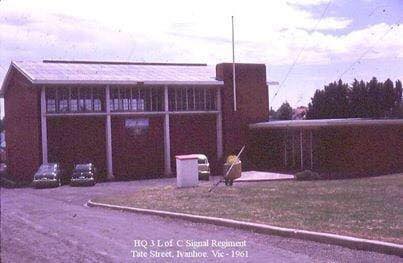
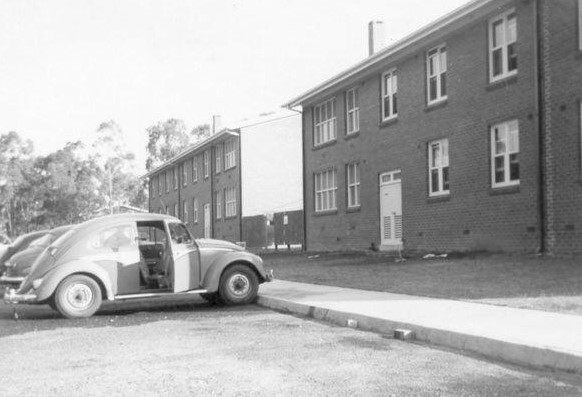
Photo (Right): LSF Sig Sqn, OR Barrack, Watsonia
In those early days the command staff of 3 L of C Sig Regt was Lt Col Harry (One-lung) Dixon (CO), Maj (Skeeta Boots) Perman (2IC/Adjutant), Capt (Butch) Powell (QM), WO1 (Lightning) Lennie (Sparrow) Thompson (RSM), SSgt Bones Irvine (RQMS) and Jughead Johnson (Clerk). The staff of LSF Sig Sqn at Westgarth depot was Lt Bruce Evans (OC) and Cpl Luke Cherry.
A few months later WO2 Les Johnston
(SCC), SSgt (Rockspider) Humphries (OKC) and Cpl Fred Gunning (OWL)
arrived. These NCOs, were the backbone of our unit, and OR’s
had great admiration and respect for them.
Later arrivals were Sgt Bert McSweeney (Tpt
Sgt), Cpl Ron Goolie (Dvr), Sgt Kev (KP) Pearson (SCC) and Marcus
(Tell us another story) Irvine (SCC), Cpl Bob Fields (OWL) (Ex SAS),
Cpl Andy Milton (Dvr), Sgt Les Douglas (SQMS), Sig Blue McEwan (RM)
and Sig Hank Stoffels (Tech TG).
Later after our course arrival into the unit
Sig's Darryl Croucher, Tiger Lyons, Jock Lowson, Popeye Sams, Gino
Baldwin, Blanco Bradley, Farmer Giles, Marino Palendri (9/60
Course), and marched into the squadron. In early 1961
Croucher, Lyons, Lowson, Diddams and Van Sam Beke marched out the
Sqn to 1 SAS Coy.
Equipment
The squadron had only rundown WW2 equipment
and it was real excitement when a number of brand-new Studebakers
arrived, dated 1942, and had only a low mileage on them (Bandiana to
Westgarth), brand new TG-7Bs dated 1941, a couple of crates
containing brand new Harley Davidsons, and brand new 303’s packed in
grease.


Photo (Left): Studebaker 6x6
Photo (Right): 303 Rifle
Cpl Fred Gunning set up a Collins receiver
in one of the rooms and the OWL operators practised morse receiving
by listening in onto the Police WT Net, receiving at speeds of
18wpm. Fred was an experienced operator. We were also
all impressed with his brightly painted Pink FJ Holden, which was
well known throughout Watsonia area. I remember one exercise
were Fred sat in front of a TG-7B working a duplex circuit on the
one piece of equipment. Fred was typing blind and sending
directly to another terminal, and at the same time it was receiving
incoming traffic in page form on the same equipment.


Photo (Left): Teleprinter TG-7B
Photo (Right): Transmitter WS173
Later we received our first batch of WS173
(RAAF) Transmitters and new Collins receivers. We had WS62
sets but they were usually a hopeless radio set. WO2 Snow
McHugh (Technician) who used his bush expertise and he design
special aerial tuning amplifiers to boost up the output of the 62
sets, which were attached to the aerial mounting outside of the
vehicle. The amplifier unit was encased in a jam tin, and to
load up the WS you had to firstly tune the WS up, then go outside
and tune up the amplifier by holding a pencil about one inch from
the aerial. While tuning it, an arc of radiation would jump
from the aerial to the pencil tip, and as the arc got brighter, the
aerial was considered loaded and tuned. We blew a lot of sets
up and had a few nervous operators!


Photo (Left): Radio Set
WS62 Photo (Right): Radio Set WS42
Later we received some C11 and WS42 sets.
In those early days we generally exercised in and around the
Dandenong hills, doing restoration work on different stages on the
“Puffing Billy Restoration
Project”. We cleared the old railway line of blackberry
bushes around the McKenzie Creek area and installed metal poles for
line communications to be used at a later date. We also
exercised on Swan Island where Sgt Block Howe and his Linies were
laying cable throughout the area. During one of the exercises
Lt Bruce Evans took his Morris Minor and his boat down to Swan
Island, and during our leisure hours we went boating around the
lower part of Port Phillip Bay.
Exercises
LSF Sig Sqn was involved in many exercises,
and spent 9 months out of 12 months on exercises. Our longest
time away from Melbourne was six months. We left on Good
Friday, Easter long weekend 1961 and arrived back on Melbourne Cup
Day. We listened to the Cup outside of Albury. We
conducted a number of preliminary shake-up exercises and post
shake-down exercises before Exercise Ice-breaker (Oct 1961).


Photo (Left): SIGCEN on
back of a
Studebaker (1961)
Photo (Right): Dick Schaefer working WS62 Radio Set
Prior to Ex Icebreaker our SSM arrived, WO2
(Angry Ant) Mick Attrill, who later became the RSM of the School Of
Signals in the late 60's. Maj Condor and Capt McGreevey
marched in as our OC and 2IC of LSF Sig Sqn and 2LT Doug Slade as
our other Troop Comd.
Sgt Charlie Hughes (OKC) and Sgt Block Howe
(Line Sgt) marched in and our Sqn began doing a multitude of
familiarisation courses on other trades. We use to spend a lot
of time out laying cables and doing everything that a Linesman had
to do. We were also expected to maintain our WS62s and 22s
sets, by opening the sets up and cleaning all the contacts and dust
around the valves, normally the technicians were never called out in
those days. Naturally, that all finished after the C11s and 42
sets arrived. Our SQN wasn't at full strength so we were all
expected to chip and do a bit of everything of every other trade.
I can always remember Cpl Ron Gooley, who
had a thousand kids, always said that he kept his kids entertained
by throwing a hand full of hundred-and-thousands into the wood heap.
WO2 McHugh named all his kids after the
exercises he attended.
Sgt Charlie Hughes had a serious accident at
Westgarth in mid 1961. All tradesmen in our unit were given
experience in each other tradesmen trade. We were being
trained by a Linie, LCpl Buddha Goldie, in erecting a sectionised
aerial mast in six-foot sections. The rigging gear got stuck
and we had about 3 lengths up and Charlie climbed up to release the
obstruction. As Charlie was wriggling a cable, the whole
sectionised mast collapsed. Charlie threw himself backwards
and landed terribly on his heels. He did terrible damage to
his spine, ankles and hips. I don't think Charlie every really
recovered from his injuries. Charlie was a highly respected
NCO. There is another story to tell of a DR trip to Sydney, to
return urgent dispatches to Victoria Barracks. It had to be at
Vic Bks in an hour from Ingleburn. Poor Charlie, there was no
safety belts in a Land Rover, peak hour traffic, and the DR sped all
the way to Sydney. Charlie was curled up in the front seat
with his head between his knees. Besides having a bad back, I
don't think his stomach was too well either - I was the driver.

Photo: Exercise Initiate,
Mt Donna Buang 24-28 June 1963
The night before we left for Sydney in April
1961 all the blokes had a break out, boozing up at the Red Tulip and
all the other "Dives" in Melbourne. Anyway they brought back
to camp two nice, well-respected ladies (Maureen and Gloria).
The first I knew about them was after coming home from my
girl-friend’s home, I walked into our toilet, standing there
urinating, when these Maureen and Gloria walks out of the cubicles,
and Maureen said to me: "Handy gadget you got there - soldier!"
They knew all about these gadgets, because they were accommodating
all for the same ten-pound. This ten-pound was shoved under
their pillows and as one satisfied customer left the ten pound was
removed and passed onto the next bloke going in. Those girls
lost a million that night.
When Lt Evans arrived at 0400 hours next morning to get us all
moving, these delightful young ladies where still there. It
was panic stations in all modes. These two girls were shoved
into one of the bloke’s ward-robe and locked. Gino Baldwin and
Blanco Bradley were being posted to Malaya and they were
accommodated at the Personnel Depot, Area Comd Holding Tp and they
didn't know the girls were locked away in the wardrobe. It
wasn't until our unit arrived in Albury as our first stop that be
blokes confessed to the problem with the girls in the wardrobe and
they rang Area Comd Watsonia about midday to let the other blokes
know, that was about midday.

Photo: Exercise Signal
Centre (SIGCEN) mid 1960s
We had a colourful young character in our
unit, Lofty Sneddon he was our most potential, potential in
everything (operator switchboard, driver electrician, clerk, etc).
In those days, because we did not have enough qualified tradesmen,
those soldiers who had no trade were made `Potential'. I can
remember being at Lucas Heights on this preliminary exercise before
`Icebreaker' and Lofty was having one hell of a time on the
switchboard, he had switchboard plugs everywhere and at this
particular time it seemed as though every subscriber wanted to make
a call. So Lofty, as quick as a flash removed all the plugs
and said, “Rigtho! You bastards! Start again!'. It was said
that Lofty even disconnected the Maintenance Area Commander. I
really don't know how much truth is in all of this!
We had a technician Santa Sinclair, who belonged to our Radio Relay Tp using B70s and he always seemed to be able to have a supply of grog. Anyway, I was walking past his site this night (1900 hrs) and here he is sucking on a coldie and it was cold. I said, “Were in the hell did you get that from?” and he leant over and opened the cases that the B70s are supposed to be stored in at all times when not in use, and there were a dozen bottles encased in ice and the B70s laying on the ground under a ground sheet. I can remember 2Lt Slade come running out, and started getting stuck into Sinclair, who was pissed out of his mind, and Sinclair politely said. “You gotta be kidding Sir! I'm not going to climb up that mast! If you want them tuned in! You do it!”. Sinclair’s reason for his outburst was that the rungs on the masts were slippery and wet and he wasn't going up. Sinclair was quite a character. I can’t remember what happened after that as I retreated very quickly.
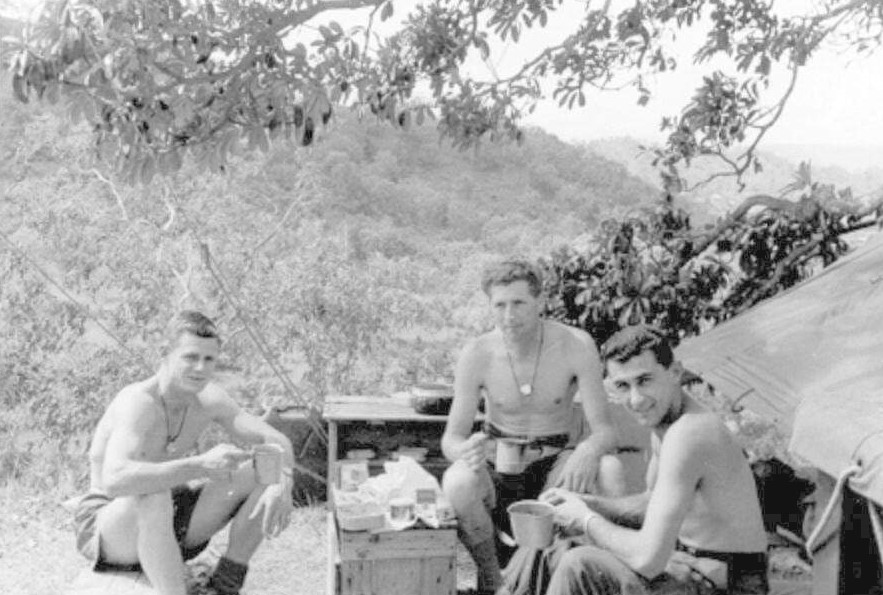
Photo: Radio Det L-R Rex Gabel, Scotty McClintock and Mario Paindri (1960)
Doug got stuck into me the following night we our voice
communications were lost completely, Doug was slamming his fist on
the fender of my Land Rover and demanding that I get comms back.
All I could say, “I am sorry Sir, but there is no radio noise on any
frequency, not even 2UE, their must be a sunspot!” Doug looked
at me and said, “Baloney Sig Parker, get comms back!'. When
communications returned next day, we discovered there was a sunspot
on the sun, and blacked-out of all worldwide communications for 24
hours due to high magnetic storm activity on the sun.
When we were
setting up our site at Lucas Heights, we were all set for Atomic
Warfare and as we belonged to the Pentropic Division and everything
had to be dug-in and under twenty-six inches of cover. We were
d digging in our Long-base Land Rover by hand and after many hours
and days one of our radio detachment members had a friend in the
Engineers, who was nearby with a piece of plant equipment and
decided to get him to come and give use a hand to finish our hole,
we were nearly three-quarters of the way through anyway.
Anyway, this equipment found an old water main and our hole filled
up with water.
On one exercise, one of our trucks were
belting down a hill on the Hume Highway to Sydney and as the driver
glanced out of the RH outside mirror (Studebakers are LH drive) he
noticed the 15KVA generator had come adrift and was overtaking the
Studebaker. At the bottom of the hill was a one-lane
bridge---have a guess who got to the bridge first?
We had a Driver Electrician who considered
that comms came first at all times and he always refilled his KVAs
while they were running. He was always warned to cease such
dangerous practice. This day I was passing him, standing up on
top of the KVA, bent over pouring petrol into the tank, and then
whoompa!!, all you could see was this ball of flame with a backside
hanging out of it.

Photo: Radio Detachment,
Bright Area deployed to communicate with other detachments on
Puffing Billy project. L-R Lance Rick, Scotty McClintlock
and Rex Gabel (October 1960)
Another colourful character we had in 3 L of
C was Sig Soda Soderholme. He had a wonderful wit and a great
ability in writing songs, something like "--- a four letter word,
called S-I-G-S".
This is about all I can remember of the good
times in 3 L of C, they may not be much, but they are fond memories.
I could tell a lot more but I think they would be unprintable.
About Exercise Nutcracker time (October 1962) I remember we have famous blokes like the following: Lofty Barry Billing, Kevin Fletcher, David Forbes-Bietsch, Stewart (Angry Ant) Leach, John (Prewitt) McEwan, Kevin (Macca) McKenzie, Brian (Smiler) Melville, Paul Ranford, Ian (Thommo) Thomson, and other names I can’t remember.
Unofficial Mascot
3 L of C Sig Regt had an unofficial mascot, a dog called “Mobile”
and one bloke remembers it was a crazy dog and was found getting it
off with a road kill beside the road. He was killed on the
road when returning from Ex Barrawinga.
Bognor Hotel Roll-Call
The unit had an unofficial roll-call at the Bognor Hotel in Castlereagh St. Sydney on the way back to Melbourne from a Putty Road exercise. The Bognor was "as rough as guts" but that didn't deter Phil Perman, Darryl Slade and Capt McCreedy from joining the boys for a few quiet beers.
Freedom of the City of Heidelberg
3 L of C Sig Regt was granted the Freedom of the City of Heidelberg and hence referred to as the “City of Heidelberg Regiment”. We all formed up in battle dress and it poured rain, and the parade was on a Sunday, the road was so wet that we appeared to be walking on water. When we lined up at Tate St, Lightning Len Thomson (CMF RSM) had to balance the parade as most of the CMF members didn’t turn up, with LSF Sig Sqn. Lightning Len was short in stature and the scabbard of his sword, one bloke said that he needed a roller skate on it.

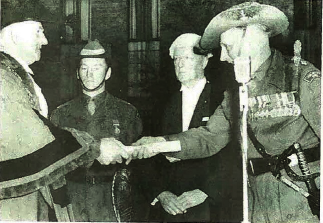
Photo (Left): 3LofC Regt
passing through the lances (Freedom of City of Heidelberg)
Photo (Right): L-R Mayor, 2Lt Doug Slade, Unknown and Lt Col Harry
Dixon (Harry receiving the Regiment's Freedom of City of Heidelberg
Certificate)
The order was given to “draw swords”. and one of the CMF guys pulled
out his sword and swished it to his right and nearly impaled the
bloke standing next to him in his chest. We marched off up
Livingstone Road with band playing and marched past the Town Hall.
The Regiment did a 'U' turn and as we again approached to Town Hall,
six Victorian Police Officers on horse back with lancers closed in
to block us. Harry Dixon, (CO) ordered “halt”, and “order arms”.
The six police officers lowered their lancers and one yelled out,
“halt who goes there”, then our unit clown, Duncan Stewart, made the
riveting exclamation, “fukin burke and wills”. Harry then replied
to the Police Officers and they allowed us to pass. Harry then
said, "slope arms" and we were carrying SLR rifles. The Regiment
halted in front of the town hall and advanced and harry proceeded to
take post at the front of the regiment. The mayor was in full
regalia including chain and cocked hat. It was funny as every time
Harry moved his sword slightly the mayor doffed his cocked hat, and
we were finding it hard to stop laughing.

On the 11th March 1965, 2
Sig Regt was formed and replaced 3 L of C Regt with the structure of
two ARA and one CMF Signal Squadron's. The new Regt remained
at Ivanhoe and Westgarth until the new compound was built and
completed at Watsonia about 1967.
Between 1965 and 1966, 2 Sig Regt prepared 709 and 527 Signal Troops
for service in South Vietnam and provided valuable service in Saigon
and Bien Hoa. In 1966, 527 and 709 Sig Tp were incorporated
into the “145 Signal Squadron (145 Sig Sqn)”, which was replaced by
“110 Signal Squadron (110 Sig Sqn) early in 1967.
145 Sig Sqn returned to 2
Sig Regt and was used as a training unit for replacements to 110 Sig
Sqn, instead of a complete replacement of unit. They provided
a flow of individual replacements to 110 Sig Sqn beginning in 1968.
110 Sig Sqn was operational and provided the rear HF link to
Australian, tape relay centres and
communication centres at Vung Tau and Saigon, a small communication security
(COMSEC) detachment at Nui Dat and provided “Deployment Troop” for HQ TF rear
link, during operations with 104 Sig Sqn.
In February 1972, with the withdrawal from Vietnam, the “Australian
Advisory Assistance Group - Vietnam Signal Detachment” was formed
and remained behind in Saigon until late 1972 before returning to
Australia.

Photo: 2 Sig Regt Elements,
South Vietnam
In 1972, the CMF was restructured and
the “Army Reserve Squadron” was disbanded and 2 Sig Regt became
fully manned with ARA.
2 Sig Regt was disbanded in 1993.